| |
|
 |
|
|
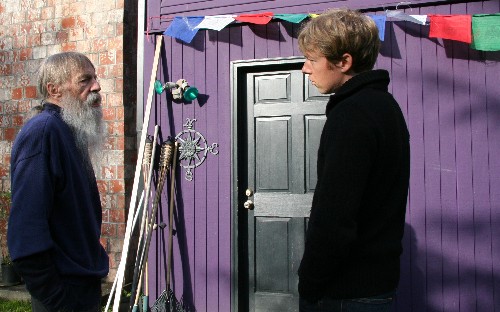
T.U. and Søren Kjærgaard outside Aleph Studios in 2008. |
|
|
In 2006, the Danish journalist Ib Skovgaard emailed his friend T.U. in Seattle to recommend he stop
by the Seattle tavern The Tractor to see and hear the group Emil de Waal+ and meet the pianist
Søren Kjærgaard.
The ensuing friendship led to Kjaergaard's return to Seattle in 2007 to record with T.U., using songlines T.U.
wrote for the occasion, with Johnny Sangster at Chroma Studios. A third trip brought the mixing and mastering,
in 2008 with Mell Dettmer at Aleph Studios. The resulting album, "Suddenly, Sound: 21 songlines for piano,
drainpipe, etc.," was released March 9, 2009, in Copenhagen, followed by a tour of Denmark.
Kjærgaard came to Seattle again in January 2010 to work with T.U. on a second album, "Alphabet, Peaceful,
Diminished: 21 Proposals from the Towers of Babble", recorded at Bear Creek Studios, again with Johnny Sangster
in the control room. The album was released Sept. 9, 2010, and the duo again
toured Denmark.
In June 2014, Kjærgaard came to the San Francisco Bay Area (where T.U. now lives) for their
third project, "Meridiana: Lines Toward a Non-local Alchemy", recorded by
The Norman Conquest at New,
Improved Recording in Oakland. The double LP was released in October 2014, followed by
a tour in Denmark.
|
|
|